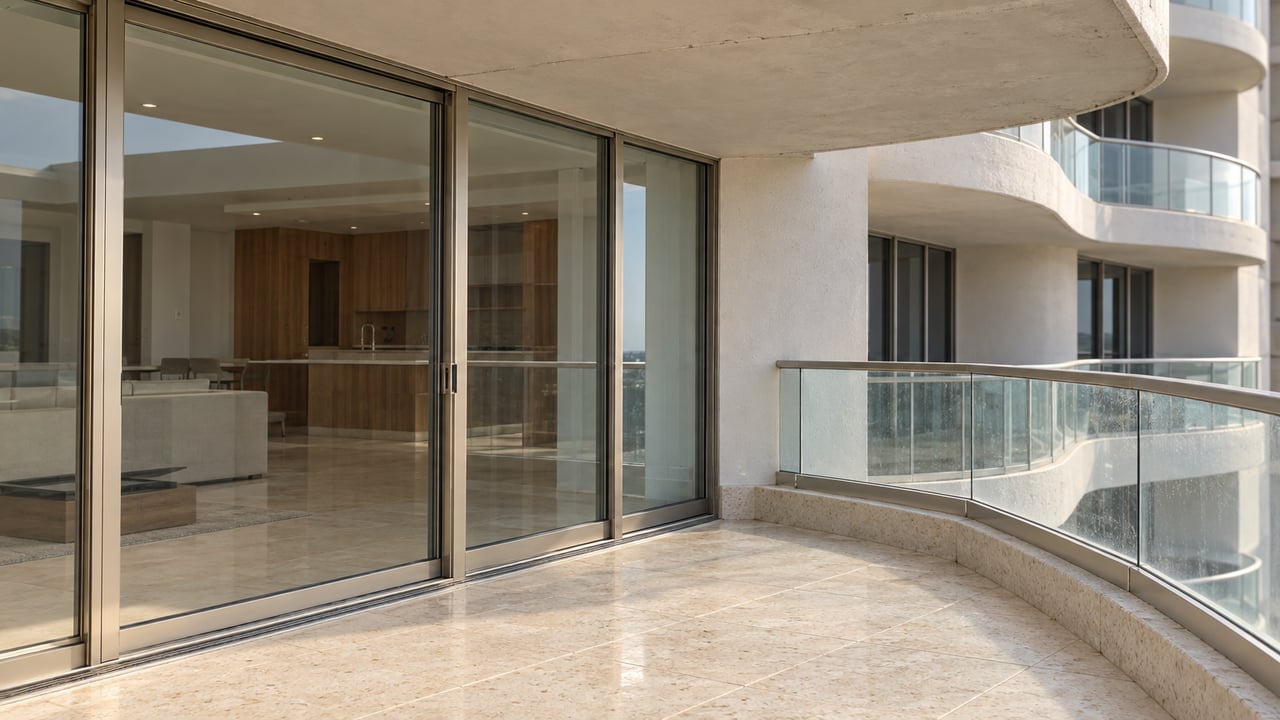
A buyer touring a 1980s tower on Brickell Key sees two numbers on the listing sheet: a price per square foot that beats the new construction next door, and a monthly HOA fee that looks almost restrained for a building with a marina and two pools. The instinct is to read that fee as good management. In some Miami buildings, a low fee may reflect reserves that have not kept pace with future repair costs.
That distinction is the one worth understanding before writing an offer this fall, because Florida's condo safety laws have reached the point in their timeline where the gap between a building that planned ahead and one that didn't shows up in real numbers, on real closing statements, in real Miami towers.
The Vote That Used to Keep Fees Low
For most of the last few decades, a Florida condo association could vote every year to waive or reduce how much it set aside in reserves for major structural components. This option allowed associations to set lower monthly fees by reducing reserve contributions. Champlain Towers South in Surfside had followed exactly this pattern before its collapse in June 2021.
The Florida Legislature closed that option with Senate Bill 4-D in 2022, refined the framework with Senate Bill 154 in 2023, and expanded it again with House Bill 913 in 2025. The mechanism that matters for buyers sits inside those bills: for any budget adopted after December 31, 2024, an association can no longer vote to waive or underfund reserves for the components covered by a Structural Integrity Reserve Study, known as a SIRS. Those components are the roof, load-bearing structure, waterproofing, electrical and plumbing systems, fireproofing, windows and doors, and any other item whose deferred repair would cost more than the state's current threshold, which ReservesPro identifies as $25,675 for 2026.
A SIRS is the engineering-based reserve study that inspects those components and produces a funding plan for the next several decades. For associations that existed on or before July 1, 2022, the original completion deadline was December 31, 2024. That slipped to December 31, 2025 under HB 913, with one further allowance: if a building's milestone inspection is also due by December 31, 2026, the SIRS can be completed alongside it, pushing the outer limit to that date. The Florida Department of Business and Professional Regulation lays out the mechanics of both requirements on its condominium inspections page, including the rule that reserves for SIRS components may not be reduced or reused for other purposes once the study is done.
None of that is administrative trivia. It is the reason a building that had been contributing close to nothing toward, say, a multimillion-dollar roof and waterproofing project suddenly has to fund that project on a fixed schedule starting now. Buildings with low reserve contributions are seeing the sharpest increases, and in some cases the reserve catch-up is large enough that a special assessment lands on top of the higher fee rather than instead of it.
Where the Bill Is Landing
The pattern by building era in Miami-Dade is consistent enough to be useful during a search.
Towers delivered after roughly 2018 are mostly insulated from this. They are years from their first milestone inspection, built to modern code, and their initial SIRS studies have generally found little to fund. Their fees have still risen, largely because of repricing in the property insurance market, but the structural reserve line is modest.
The 2004-to-2010 wave of construction in Brickell, Edgewater, and downtown Miami sits in a different position. These buildings are approaching or already inside their first 25-year milestone window. Most have completed their required SIRS by now. Some absorbed the change as a straightforward fee increase because they had funded reserves reasonably well from the start. Others, which had been voting to waive reserves for a decade or more, are the ones now issuing assessments.
The real financial pressure concentrates in buildings from the 1970s through the 1990s: older towers in Aventura and Bal Harbour, the first generation of buildings on Brickell Key, and much of the mid-century stock along the barrier islands. These associations have typically already been through one or two milestone cycles, carry genuine deferred maintenance, and in many cases never seriously funded reserves for it. Two examples from this period illustrate the range: The Cricket Club in North Miami issued a special assessment of $134,000 per unit, and Mediterranean Village in Aventura reached as high as $400,000 per unit. Those are not the typical outcome, but they show what happens at the far end of decades of deferral.
More broadly, assessments tied to this wave of compliance have run from roughly $5,000 to $15,000 per unit for smaller remediation work, up through $30,000 to $75,000 per unit for combined roof, concrete, and waterproofing projects, with a smaller number of larger Brickell and Edgewater buildings exceeding $100,000 per unit when the scope covered multiple systems at once. Reporting from Community Associations Institute and South Florida HOA attorneys in 2025 put the average Miami condo building's reserve funding at somewhere between 40 and 60 percent of the level a SIRS would require, which is the gap now working its way into budgets and assessment notices across the county.
New-construction and recent-cycle towers such as Baccarat Residences, Cipriani Residences Miami, and Aston Martin Residences in Brickell aren't inheriting this catch-up problem, since their reserve studies start from a current baseline rather than decades of deferral. Buyers there are paying a premium on price per square foot instead of a structural liability, which is its own trade-off and not a risk-free one, but it is a different risk than the one facing an older building's next owner.
What to Ask For Before You Write an Offer
Florida Statute 718.503 puts the disclosure obligation on the seller, not on the buyer's due diligence team. A prospective purchaser is entitled to the inspector-prepared summary of the building's milestone inspection report, if one exists, along with the association's most recent SIRS or a written statement that none has been completed.
Three documents turn that entitlement into something useful before you're under contract rather than after:
- The Structural Integrity Reserve Study itself, not just a summary, so you can see which components were flagged and how the funding plan handles them.
- The milestone inspection report, if one exists.
- A written disclosure of any special assessment that is current, pending, or under discussion, including recent board meeting minutes where the topic comes up.
If a seller or listing agent can't produce these within a few business days of a serious inquiry, follow up on the documents' status before proceeding.
How Condo Project Status Can Affect Financing
A pending or unresolved SIRS finding can affect more than price. Fannie Mae maintains a list of condo projects ineligible for conventional financing, largely because of unresolved structural findings or incomplete inspections. That list grew from a few hundred buildings nationally before 2021 to roughly 5,000 earlier this year, with close to 700 of them concentrated across Miami-Dade, Broward, and Palm Beach counties combined. A building landing on that list doesn't just affect the current owner. It can eliminate an entire category of buyer for the next resale, since a lender working with Fannie Mae guidelines won't approve the loan regardless of how strong the borrower is.
Checking a target building against Fannie Mae's Condo Project Manager, or asking a lender to check it, belongs in the same early conversation as requesting the SIRS and milestone inspection documents. Finding out at the appraisal stage is the expensive way to learn it.
How Miami Buyers Are Actually Structuring These Deals
A known, quantified special assessment is not automatically a reason to walk. It's a negotiating point. Discuss the assessment before going under contract rather than discovering the number during the inspection period, when leverage has already shifted.
An unquantified problem is the harder situation. A Phase 2 structural inspection underway with no cost estimate yet, or a SIRS that flags a component without a completed funding plan, is difficult to price into an offer because nobody involved actually knows the number. That is the moment to slow down rather than negotiate on unknown terms.
For Miami-Dade owners who are on the paying end of one of these assessments rather than the buying end, the county has a resource worth knowing about: the Condominium Special Assessment Loan Program, run through Miami-Dade's Housing and Community Development department, which helps owners finance required repair costs tied to building recertification.
A Few Direct Questions
Does a completed SIRS mean the building is done paying for structural work? Not necessarily. A SIRS is a funding plan, not a repair invoice. A building can have a current SIRS and still face a special assessment if the study identifies work that reserves haven't caught up to yet, or if a milestone inspection's Phase 2 findings come in after the SIRS was written.
Does this only affect older buildings? The reserve funding rules apply to residential condominium or cooperative buildings. In practice, the financial exposure concentrates in older buildings because they're the ones most likely to have voted for years to waive or reduce reserves. A newer building can still be underfunded if its board has not adequately funded reserves, and an older building can be in excellent shape if its board started planning early.
A building's paperwork now tells you as much about what you're buying as its view does. Before you write an offer on a Miami condo built before the late 1990s, it's worth having someone pull the SIRS, the milestone inspection status, and the assessment history alongside you, not after the inspection period has already started the clock. Privé Advisory Group can walk you through what a specific building's documents actually say before you commit to a number. Request a Private Call to start that conversation.
This article is general information, not legal, tax or financial advice. Consult a qualified professional about your situation.