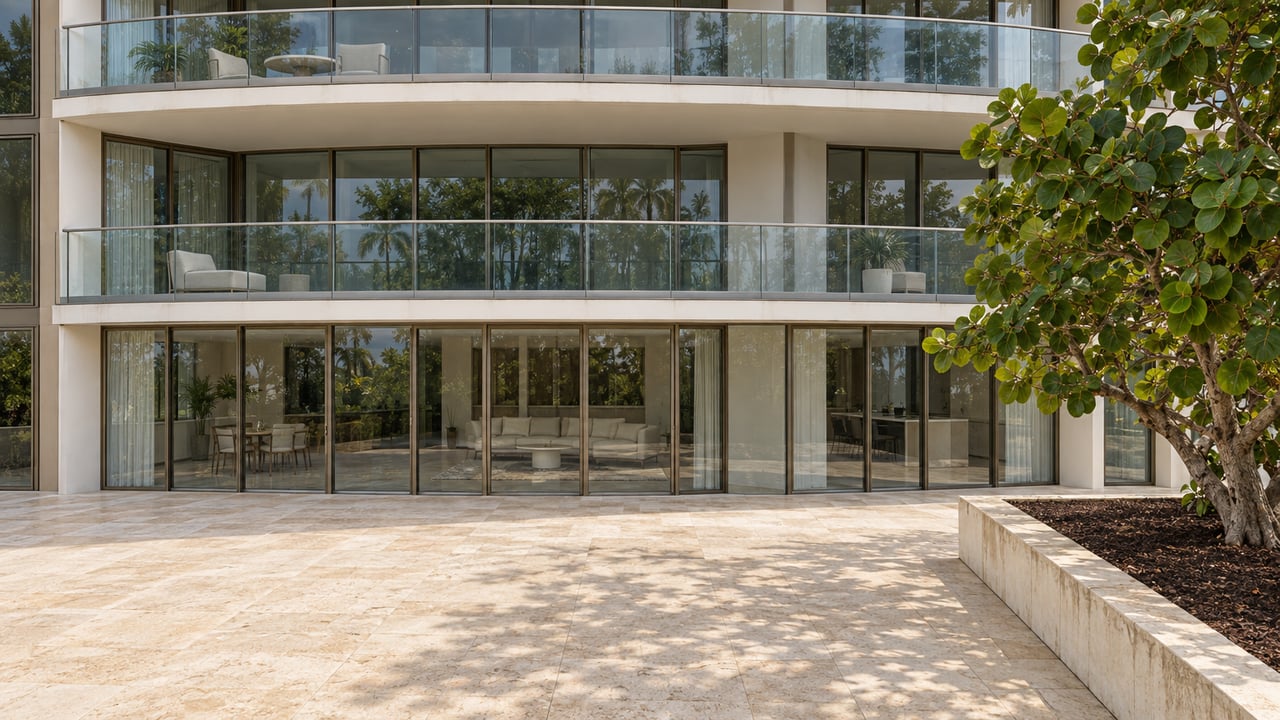
"Two Roads and I are very happy to have this behind us and move forward," Taylor Collins told The Real Deal at the end of August 2026. He added that the process had been "very emotional for both sides." Two Roads Development had just settled with the remaining owners at Biscayne 21, the 13-story, 192-unit bayfront building at 2121 North Bayshore Drive in Edgewater. Back in 2022 it paid about $150 million for a majority of the units. A source told the publication that the final group was paid about $50 million.
Biscayne 21 is the loudest example of a pattern that runs through Miami's recent collective condo sales. Under Florida law, the last units a developer needs are often worth far more than the first ones it bought. If you are looking at an older building, the rules behind that pattern belong in your due diligence along with the floor plan.
The Arithmetic of a 5% Veto
Florida's optional termination rule is in Section 718.117 of the Florida Statutes. A residential association needs at least 80% of all voting interests to approve a plan of termination before it goes to the state. If 5% or more of the voting interests reject the plan, by voting no or in writing, it cannot proceed. Voting interests cannot be suspended for the vote, and after a rejection like that, no new plan can be considered for 24 months. The 2026 statutes keep those terms unchanged. The statute's history lists no amendment to the section in the 2026 session.
That 5% line is low. A declaration sets how voting interests are allocated, but in a 39-unit building where each unit casts one equal vote, 5% is 1.95 votes, so two units would be enough to block a plan. Under the same assumption, a 192-unit building would need ten. A developer can buy a supermajority on the open market at ordinary prices, but the 24-month wait after a failed plan costs money too. Every month of delay is a month of carrying costs on units it already owns.
Bayshore Park, Round by Round
Bayshore Park shows how this plays out in practice. It is a 39-unit building at 2545 South Bayshore Drive in Coconut Grove, built in 1967, across the street from Monty's Coconut Grove and the marina. Mast Capital had been buying units there since the mid-2010s. It started with a two-bedroom for $240,000 and built up to 16 units bought at prices between $261,000 and $450,000. The Real Deal reported the rest of the sequence in March 2026.
| Stage | Units | Reported price | Average per unit |
|---|---|---|---|
| Mast's earlier purchases, mid-2010s onward | 16 | $261,000 to $450,000 each | Not reported |
| BH Group and Mast joint venture, May to June 2025 | 32, including Mast's 16 | $21.1 million combined | $661,843 |
| Final buyout, reported March 2026 | 7 | About $6.9 million | $985,714 |
| Full building | 39 | About $28 million |
After the 32-unit round, the joint venture held about 82% of the building's units. If each unit carries an equal vote, that is just past the 80% approval threshold. The seven remaining units made up roughly 18% of the building, more than three times the 5% share the statute treats as enough to block a plan. The final seven owners were paid nearly $324,000 more per unit on average than their neighbors had been paid the previous summer. Records show they had bought in the early 2000s for an average of about $100,000. The developers plan to terminate the association and build a luxury condominium on the site. Isaac Toledano said they "hope to announce our proposed project later this year."
The order of sales sets the price curve. The 2025 round priced units against each other, and the 2026 round priced the last block that stood between the developers and a termination plan.
When the Declaration Asks for Everyone
The statute's 80% is the general rule, but an older building's own declaration can set a higher bar. Biscayne 21 is the case Miami practitioners now point to. Its declaration required 100% of owners to terminate. After Two Roads bought its majority, the developer-controlled association amended the declaration to lower that threshold to 80%. Owners who had not sold sued in 2023.
In Avila v. Biscayne 21 Condominium, Inc., Third District Court of Appeal case 3D23-1616, the revised opinion filed July 10, 2025 held:
"an amendment changing the voting threshold for termination from 100% to 80% impacts the voting rights of the unit owners."
The court also found that this declaration did not contain language automatically importing the later 80% statutory threshold. Under this declaration, the amendment needed unanimous approval. The appeal came from the denial of a temporary injunction, and the court reversed and sent the case back for an injunction to be entered. According to The Real Deal's timeline, the Florida Supreme Court declined review in October 2025. When The Real Deal reported the settlement on August 31, 2026, a court still had to sign off on it. Once that happens, Two Roads can demolish the building and move forward with Edition Residences.
In a building whose declaration requires unanimity, the 5% veto becomes a single-unit veto. The same dispute is now open in Miami Beach. At the 120-unit Amethyst, 5313 Collins Avenue, Mast Capital had acquired 35 units by March 2026, and a suit was filed challenging an amendment that lowered the termination threshold from 100% to 80%. The Real Deal's March 27, 2026 report is the latest update in our research.
The Floor Beneath Every Remaining Owner
The holdout premium is the ceiling. The statute also sets a floor once a single bulk owner, together with related entities, holds at least 80% of the voting interests when the plan is recorded. In that situation, the plan must meet these conditions:
- Every owner other than the bulk owner receives at least 100% of fair market value, set by an independent appraiser chosen by the termination trustee, as of a date no more than 90 days before the plan is recorded.
- Owners whose units carry a homestead exemption, or that are owner-occupied operating businesses, and who are current on association obligations receive at least their original purchase price.
- Homesteaded owners receive a relocation payment equal to 1% of the termination proceeds for their unit, paid by the bulk owner.
- If the units are later offered for lease, an owner in occupancy may lease the former unit for 12 months on the terms offered to the public, if the request is made in writing within 90 days of recording.
The statute's definition of fair market value includes units sold in bulk purchases and excludes wholesale and distressed sales. Each completed buyout can therefore feed into the comparables for the next one. A separate route covers older buildings in poor condition. If qualifying repair costs exceed the units' value after repair, or land-use rules make reconstruction impossible, termination can proceed at a lower vote. That vote is the lesser of the vote needed to amend the declaration or the declaration's own termination threshold.
Where Miami's Buyouts Stand in October 2026
The holdout dynamic shows up differently depending on where a deal is in the process. Here is the status of each deal in our research, as of the date of each report:
| Building | Location | Status | Reported figures |
|---|---|---|---|
| St. Louis, 800 Claughton Island Dr. | Brickell Key | Negotiating, April 2026; possible 2027 closing | 134 units; one source estimated about $1.5 million per unit, roughly $200 million |
| Mutiny, 2951 S. Bayshore Dr. | Coconut Grove | Offer, January 2026 | 170 units; $160 million offer from BH Group |
| Virginia Pointe, 3245 Virginia St. | Coconut Grove | 59 of 66 units acquired, March 2026 | $27.7 million, $470,000 average; held as rentals |
| Mariners Bay, 12000 N. Bayshore Dr. | North Miami | Completed, November 2025 | 46 units; $48.5 million |
At the St. Louis, the declaration requires 80% approval, and owners representing nearly 80% were in negotiations, according to the April report. At the Mutiny, the same $160 million figure had come earlier from Slate Property Group, and a DaGrosa Capital offer fell through in 2024. At Virginia Pointe, the seven unacquired units are more than 10% of the building's units. Canero Group has said the building will be operated as rentals, with no immediate redevelopment plans. That leaves those seven units outside any termination vote for now.
Reading an Older Building Before You Buy
A unit in an older waterfront building gives you a home and a fractional vote on whether the building continues to exist. The bulk-sale prices above show how differently those votes have been priced depending on timing. Before you make an offer, these documents and questions show where a building stands:
- The declaration's termination clause. Find out whether it requires 80%, a higher share, or unanimity, and whether it has ever been amended.
- Concentration of ownership. Check whether one entity, or a group of related entities, holds a large block of units. Bayshore Park's first buyer started with a single two-bedroom.
- Association minutes and correspondence. Look for any record of bulk offers, termination proposals, or a rejected plan that started a 24-month clock.
- Litigation. Ask whether the association is party to any suit over voting thresholds or amendments.
This post is general information about how Florida's condominium termination rules operate. It is not legal, tax, or financial advice, and a real estate attorney can tell you how a specific declaration and set of facts apply to you.
If you are weighing an older Miami condominium and want to understand its termination clause, its ownership pattern, and any buyout history before you commit, Privé Advisory Group reads these buildings from the developer's side as well as the buyer's. Request a Private Call and we will go through the documents with you.